

Transforming the passenger experience
Is your airport ready for the future of air travel? Biometrics is reshaping the industry, offering faster, more secure, and touchless journeys. Stay ahead by choosing an end-to-end biometric solution that fits your airport's evolving needs.

The next step in seamless travel
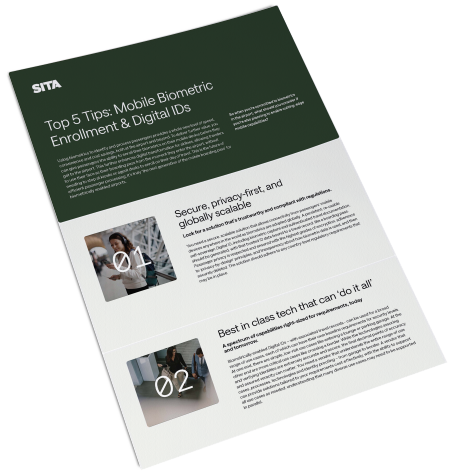
What’s the next frontier in biometric innovation? Mobile enrollment takes biometrics even further. No kiosks, no agent desks – just seamless, hassle-free travel. Discover more and unlock cutting-edge mobile capabilities.
Biometrics in action
Airports and airlines are adopting SITA’s biometric technology to enhance security and improve the passenger experience.
Global air travel is expected to surge. Biometric systems offer the ideal solution to increase airport capacity, streamline passenger flows, and reduce queues. SITA's biometrics systems are currently in use at 40 airports worldwide, including major hubs like Doha and Beijing.

What are the benefits of biometric technology at airports?
Biometrics may sound like one of those subjects you didn’t enjoy at school. While SITA’s tech is sophisticated, the biometric process is remarkably smooth and simple for airports, airlines and passengers. Biometrics check-in solutions offer opportunities for airports and airlines to create seamless passenger experience that works like clockwork – speeding up passenger flows, cutting costs and reducing the need for human intervention.
Integration

Enrollment

Verification

This has three clear benefits for airports and airlines, and at borders:
It’s quicker and easier to process passengers with biometrics. In short, you get shorter queues. No more fumbling for boarding passes; no more juggling baggage; not more asking for identity cards.
Machines are simply better at facial recognition than your staff. Biometric matching is faster and more discerning – so the system is more efficient, reliable and secure. This helps speed up all subsequent security processes as the system recognizes the same person.
Privacy is assured. Passengers remain in control of their own information, giving permission to share only as much data is required at each stage of the journey.
Biometric security solutions make boarding at borders simpler. Using facial recognition, biometric devices check your identity against databases such as the USA’s Custom and Border Protection service. Effectively, your face can become your passport.
Built on SITA’s long track record in aviation innovation, our tech is years ahead of the competition.
In addition to running biometrics at major international airports such as Doha and Beijing, SITA successfully completed an end-to-end trial at leading tourist destination Aruba. With SITA’s Smart Path program, verified passengers were able to walk straight off the plane and head for their hotels without time-consuming passport control.

How does facial recognition improve air travel security?
Some people wonder if biometrics raises issues of security and privacy for passengers. This may be true for a small cohort of particularly sensitive customers. So it’s important to offer passengers reassurance on privacy and security, as well as an ‘opt-out’ option.
In reality, most biometric data for air travel use is temporary. The system is only interested in one-time information at the point of travel, and the data is deleted immediately thereafter.
For ‘permanent’ travel credentials, such as passports or visas, the data is securely stored but that’s not any different from how these systems work currently.

World leader in travel tech
SITA’s experience is that passengers like biometrics. And for one very simple reason: their journey is simpler, quicker and smoother. For example, biometrics make secure self-drop baggage a reality – with big operational benefits and cost-savings for airports and baggage handlers.
And when you think about other services which often use biometrics – such as your banking app – it’s plain that the security benefits are valued by customers. When your face is your own private, secure key to services, you are literally recognized as an individual.
So, like the old Amex campaign “Do you know me?”, biometrics also allows airlines and airports to recognize different types of customer:
- Can facial recognition give loyal customers access to lounges
- Can you offer targeted discounts in airport stores, preferential booking in restaurants or simplified hotel check-in and car hire pick-up?
- Can you offer additional support to passengers with special needs, for example, helping you comply with the Americans with Disabilities Act (ADA).
In this way, biometrics makes it simpler to offer a tailored customer experience – while increasing the efficiency of operational resources.
Real world innovation



Years ahead in
biometric innovation
With decades of operational experience at airports, we know what it takes to keep delivering stellar service to demanding passengers (and stakeholders) in a fast-moving, live environment.
Learn more about the future of airports in our Biometrics White Paper.