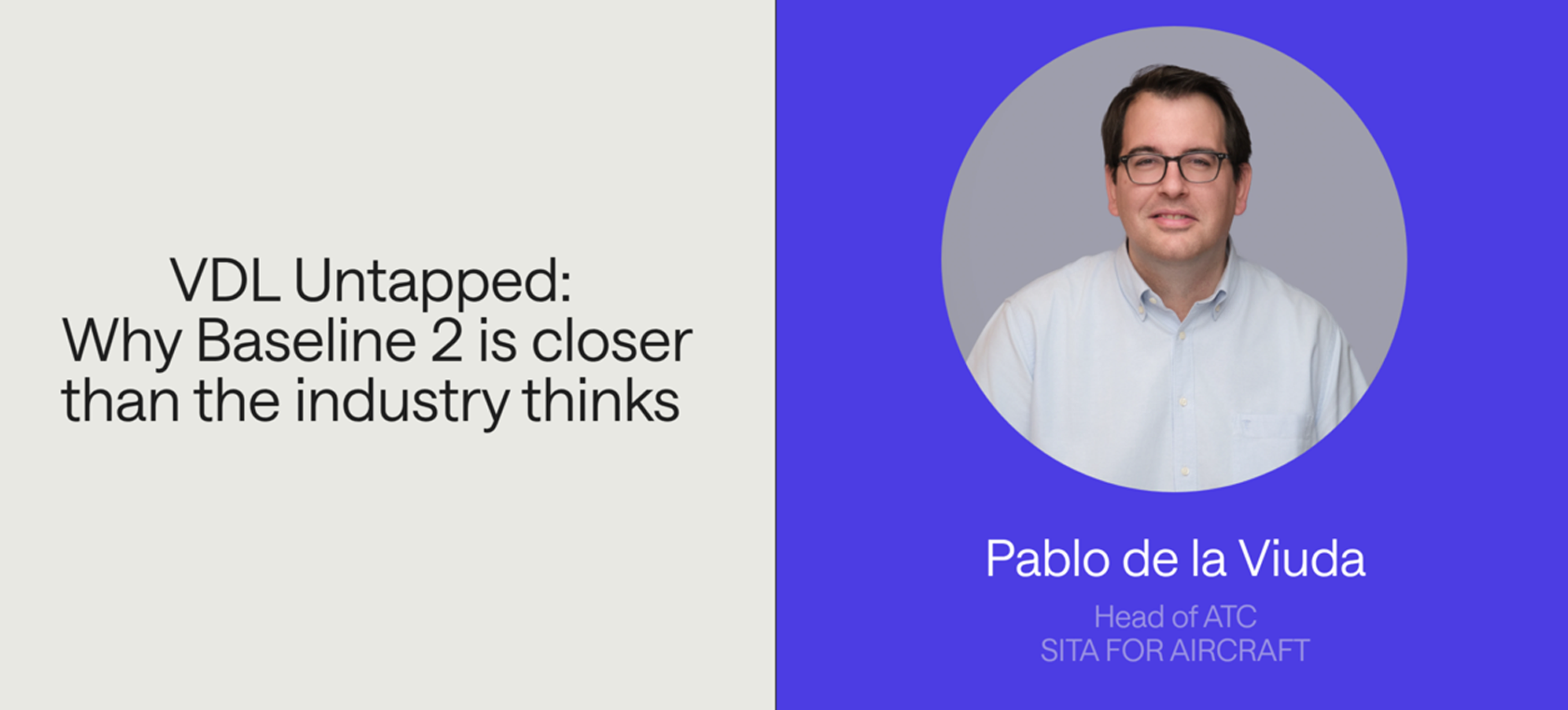


VDL Untapped: why Baseline 2 is closer than the industry thinks
Airspace World 2026 confirmed the need, and ANSPs can act now


The data link conversation is changing. For Pablo De la Viuda, Head of ATC at SITA for Aircraft, three days at Airspace World 2026 in Lisbon confirmed that.
The conversation had shifted, not in tone or format, but in substance. The questions ANSPs were asking about Controller-Pilot Data Link Communications (CPDLC) were sharper and more forward-looking than a year ago. And understanding what’s driving that shift starts with a concept about Very High Frequency DataLink (VDL) that the industry hasn’t always gotten right.
"VDL is here to stay," Pablo says. "It's a proven technology. It has taken CPDLC to the level it is today."
Data link is an ecosystem, not a network
One question echoed at the SITA booth: Why do performance metrics sometimes disappoint even when the network is doing exactly what it should?
The answer is often misunderstood. Data link is not a network in the traditional sense. It is an ecosystem. Performance depends on every player in the chain, including how aircraft behave when they receive or transmit a message. If some aircraft in a given airspace have outdated or poorly configured avionics, the whole chain feels it.
"It's the work of a lot of parties, a lot of moving parts," Pablo says. "And that's why performance can really suffer whenever some players aren't acting in a harmonized way."
Performance improvement, Pablo argues, is a collective responsibility. Not just SITA's. Not just ANSPs'. Every player in the ecosystem has a part to play.
The number that should be in every boardroom
CPDLC is the only technology today that actually increases airspace capacity. Voice simply cannot keep pace with the volume of clearances required at peak traffic. In the central months of the year, if CPDLC is unavailable in major European airspaces like Germany or France, capacity must be reduced by 20 to 35 percent.
" CPDLC is actually creating capacity," Pablo says, "allowing more aircraft to be packed into the same airspace volume when traffic is really high."
That’s not theoretical. It’s happening. When the industry talks about investing in data link infrastructure, it is not a question of preserving old technology. It is a question of protecting the mechanism that keeps European airspace running at the volume it runs at today.
VDL Untapped: the capacity that is already there
The question Pablo heard most in Lisbon was whether VDL can genuinely sustain Baseline 2 services as traffic grows.
When Baseline 2 was first conceived, many ANSPs believed it was impossible to sustain those services on VDL alone. That concern made sense at the time. The situation today is different.
"VDL capacity is a concern, but not a problem," Pablo says, "because it can be managed."
More channels are available than much of the industry realizes. The frequencies can be deployed. The architecture supports it. VDL can sustain the whole system for at least a decade, possibly two.
How do we know? SITA’s VDL Untapped provides a roadmap of planned frequency expansions, optimization initiatives and capacity enhancements.
VDL Untapped is not optimism. It is engineering. Capacity that exists but has not yet been activated.
"It's just about the whole ecosystem and the relevant stakeholders coming together and deciding on it," Pablo says.
For ANSPs finalizing capacity plans for the late 2020s, Pablo is clear: the constraint is not the technology.
"VDL will remain the baseline medium for data link for the years to come," he says. "And we are working with ANSPs to keep that momentum going for at least another decade."